07/2015: Living on Mars (R. MacDonald)

Place and Time: Abingdon, July 23, 2015 at 19:30

Title: Living on Mars – A Beginner’s Guide

mars-bgHumans will go to Mars one day. But what if we skipped the plant-a-flag stage, and instead built a permanent human settlement on Mars in, say, 2027?

What challenges will need to be overcome to make this a reality, and how can they be dealt with? What technologies will be needed for a small community to survive (and ultimately thrive) on the red planet? How might the early Martian pioneers engineer unique solutions as they construct the first society on another world?

In a first for human space-flight, the Mars One project intends to send 4 people on a one-way mission of permanent settlement to Mars in 2027. This will be preceded by a series of unmanned precursor missions, the first one of which is planned for a 2020 departure. What makes Mars One unique is that it is entirely privately funded, international, and apolitical, which enabled it to launch a global astronaut selection process in 2013 – to which over 200,000 people from over 140 countries applied.

After a series of cuts, there are now just 100 people remaining in Mars One’s selection process. By early 2016, 24 will be chosen to enter full time astronaut training for the mission.

In this talk Ryan MacDonald will explore the architecture of Mars One’s mission. A special focus will be on how a one-way trip using just existing technology is not only possible, but is substantially simpler and cheaper than previously proposed return missions.

Speaker: Ryan MacDonald

Ryan MacDonald has just finished his degree in physics at the University of Oxford and is now pursuing a DPhil in Astronomy at the University of Cambridge. At the same time, he is one of the last 5 British Mars One Astronaut Candidates.

Further information about the speaker

06/2015: Visit to Joint European Torus (JET)

There will be no talk in June. Instead we are currently organising a visit for Atom Society members to visit the Joint European Torus (JET) at Culham. The visit will be on June 25 and start at 18:00.

JointEuropeanTorus_internal

There are 30 places that will be allocated on a first-come-first-served basis.

Reserving your place

To reserve a place, please email the secretary secretary@atomsociety.org.uk as soon as possible, stating your full name (you will need a form of photo identification to be admitted to the centre). We’ll let you know, if you were one of the first 30 members to be guaranteed a place and otherwise add you to a waiting list.

About the tour

The tour will start at 6pm on Thursday 25 June and last for about two-and-a-half hours. We’ll start with tea/coffee followed by a 30 minute talk introducing Fusion and then the tour of the facility.

Getting there

The easiest way to get there (postcode OX14 3DB) is by car. We may be able to offer you a lift, if you cannot get there on your own; please email us and we’ll see what we can do.

Mobility

The Centre can make arrangements for special mobility needs but requires advance notice, so please let us know once we have confirmed your place.

Pacemakers or automatic drug dispensers (implants)

Please let us know if you have either of these so that we can notify the Centre in advance, as it may affect access to a few parts of the tour.

On the day

You’ll need photo identification, such as a passport or driving license.

05/2015: Fluorescence image-­guided surgery (B. Vojnovic)

Time and Place: Thu, 28 May 2015, 19:30, Crown and Thistle (Barn Room), 18 Bridge St., Abingdon (note change of venue)

Presenter: Professor Boris Vojnovic, Cancer Research UK and MRC, Oxford Institute for Radiation Oncology

Title: Fluorescence image-­guided surgery: prospects and challenges

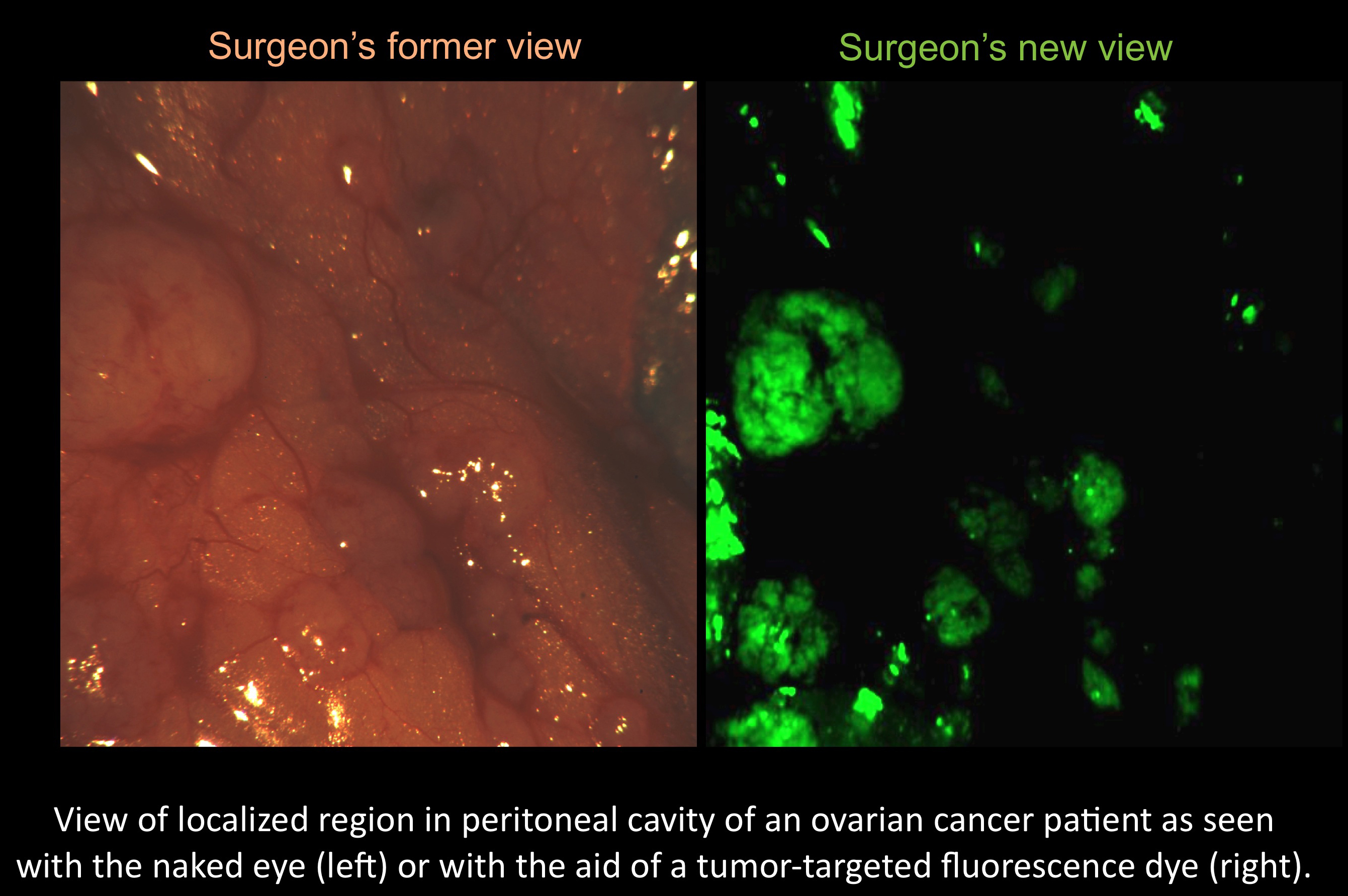
A surgeon's view of ovarian cancer cells with and without the tumor-targeted fluorescent imaging agent. (Image courtesy of Philip Low)

A surgeon’s view of ovarian cancer cells with and without the tumor-targeted fluorescent imaging agent. (Image courtesy of Philip Low)

04/2015: Neutrinos (A. Weber)

Time and Place: Thu, 23 Apr 2015, 19:30, Kings Head and Bell (King Charles Room)

Presenter: Alfons Weber (University of Oxford & STFC/RAL)
Professor Alfons Weber is a physicist working at the Physics Department of the University of Oxford and at the Rutherford Appleton Laboratory in Harwell. He started off as a theoretician, but has now worked for more than 20 years in experimental particle physics all over the world, from CERN in Switzerland, Fermilab in the USA and J-PARC in Japan. He develops detectors for neutrino experiments and analysis the data to reveal their secrets. He is also a Fellow of Pembroke College, Oxford where he is teaching physics for undergraduate and graduate students.

Title: Neutrinos – The Ghostly Shape-shifters
Neutrinos are some of the most abundant particles in the universe, but very little is known about them. This talk will tell you why neutrinos were originally “invented”, why they are important to understand and give you a glimpse of their strange properties: They can travel through light years of lead without being stopped; they can change from one particle to being another; they may be the very reason, why we are here.

SK

02/2015: Looking inside the Brain (W. Trigg)

Time and Place: Thu, 26 Feb 2015, 19:30, Kings Head and Bell (King Charles Room)

Presenter: William Trigg (GE Healthcare)
William Trigg is currently a Project Leader in the Life Sciences Business within GE Healthcare leading projects in the development of novel PET tracers for brain imaging.  He has worked in the pharma/diagnostic industry for 17 years after gaining a degree in Pharmacology and Chemistry from Sheffield University and a PhD in Medicinal Chemistry from the University of Bath. He has published 19 papers on Chemistry, Radiochemistry and imaging and has made more than 10 patent applications in the pharmaceutical and diagnostic area.

Title: Looking inside the brain
The human brain is the most complex structure in the known universe and for many years the only way to study the brain was to take it out of the person which has severe consequences for its owner! Given the increasingly ageing population, the prevalence of brain disease and particularly neurodegenerative disease is an increasing problem for society and has fed the need for non-invasive techniques to study the brain’s structure and function. Here I will introduce the techniques used to study the brain in the clinic and in the research setting with a focus on molecular imaging.